Config Manager
Config Manager
The Config Manager is the utility for bundling selected pieces of your system configuration into a single, portable config that you can save to a file, share through the cloud, edit (including with AI), and import into this or another system. A config can hold any mix of Users, Teams, Record Types, E-forms, Work Triggers, Add-Ins, Action Sets, Custom Variables, Package Templates, and Merge Templates. Nothing is changed in your live system until you explicitly choose Save Into System, so you can load, review, edit, and rearrange a config freely before committing it.
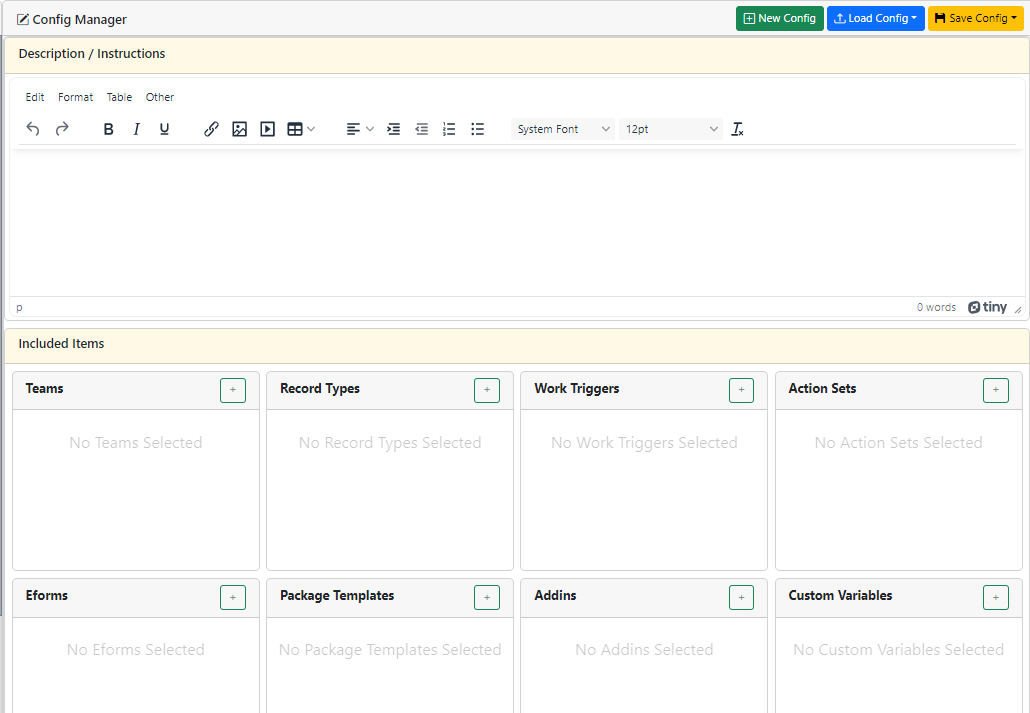
The Screen Layout
The Config Manager is divided into three areas. On the left is the Config Items panel, which lists every object currently included in the config, grouped by type with a count badge on each group. The center area holds the Config Description / Instructions editor along with the AI review cards (Review of Request, Summary of AI Results, and Potential Issues / Warnings) when AI has been used. On the right, when AI is enabled for your system, you will see an AI Usage Snapshot gauge and a rotating "Did you Know?" tips panel.
Toolbar Buttons
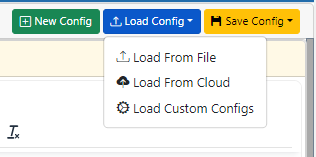
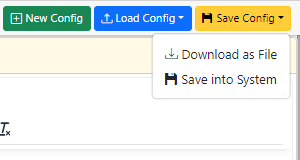
The toolbar across the top of the screen gives you the main actions. Save Into System imports the currently loaded config into the system you are signed into. The Download button (the download icon next to Save) saves the config out to a JSON file on your machine. The Load Config dropdown offers two ways to bring a config in: Load From File and Load From Cloud. New Config clears everything out and starts you over with an empty config. When AI is enabled, a Create and Edit with AI button also appears in the screen title.
Config Items and Status Icons
Each object in the config shows an icon that tells you exactly what will happen to it when you save the config into a system. A blue AI sparkle means the item was generated by AI and will be added as a brand new object on save. A red entry icon means an item with that identity already exists in the current system and will be overwritten on save. A green add icon means the item was imported from a file or the cloud and will be added as a new object on save. Click any item to open it for review or editing, and click the trash icon to remove it from the config.
Adding Items From Your System
To add existing objects from your system into the config, click the green plus (Add Items) button in the header of the relevant group, such as Users, Record Types, or Work Triggers. A selection panel slides in listing everything of that type in your system. Check the items you want, using the [ALL] and [NONE] shortcuts to select or clear the whole list quickly, then click OK to pull full copies of those objects into the config. For Work Triggers and other hierarchical lists, holding Ctrl while checking a parent also checks all of its child items. Merge Templates cannot be added this way because they travel with the objects that reference them rather than being added on their own.
Reviewing and Editing Items
Clicking an item in the Config Items panel opens it in the same full editor used on the regular admin screens, but in preview mode. This lets you inspect and change the item as it exists inside the config without touching your live system. Within these editors, references to other objects, such as the teams used in a Record Type's security, are resolved against the other items in the config, so a config can be reviewed as a self-contained unit. Use Save and Close to write your changes back into the in-config copy. Merge Templates are read-only in the Config Manager; clicking one downloads the underlying document so you can view it.
Config Description and Instructions
The Config Description / Instructions editor in the center of the screen lets you record notes for whoever will use this config later. When a config is loaded from a file or the cloud, these instructions are shown at the top before the user imports it, so this is the place to explain anything they need to know, such as how to map users to the included teams, what other resources are required, or any setup steps that fall outside the config itself.
Load From File
Configs are saved as JSON files. Load From File brings a saved config into the Config Manager so you can review it, edit it, and optionally import it. You can also load a config, make changes, and download it again to a new file without ever importing it into a system, which is ideal for building and maintaining a library of reusable configs.
Load From Cloud
Load From Cloud connects to the docMgt online configuration library and lists the shared configs available to you. Expand any entry to read its description, version, and date, then click Preview to load it into the Config Manager. As with a file, loading from the cloud only stages the config for review; nothing is imported until you choose to save it into your system.
Saving and Importing
There are two ways to save. Download writes the current config out to a JSON file on your machine for sharing or safekeeping. Save Into System imports the currently loaded config into the system you are signed into, creating new objects and overwriting existing ones according to the status icons shown on each item. You are asked to confirm before an import runs.
Create and Edit with AI
When AI is enabled for your system, the Create and Edit with AI button lets you build and modify configuration objects using plain language. In the AI dialog you describe what you want, for example "Make a Record Type for HR Documents and make sure only the HR Dept team can see it" or "Rename the Invoices record type to Vendor Invoices and remove the QA team from its security." The object types AI can create and edit are Record Types, E-forms, Workflow, Add-Ins, Action Sets, Users, and Teams. You can request brand new objects and changes to existing ones in the same request; to have AI edit an object that already exists, first add it to the config and then describe the change you want.
You can also upload files in the AI dialog. PDF, Word, and image files are converted into E-forms, with each uploaded file becoming its own E-form. The request runs as a background job, and when it finishes the generated objects are loaded into the Config Manager for you to review. The center cards summarize what happened: Review of Request restates how AI understood your ask, Summary of AI Results describes what it produced, and Potential Issues / Warnings flags anything you should check. Review each item by clicking it, ask AI for further changes if needed, and when everything looks right use Save Into System to commit the config. The AI Usage Snapshot on the right shows your AI processing for the month, and the token count for the most recent job is shown beneath it.
See also